

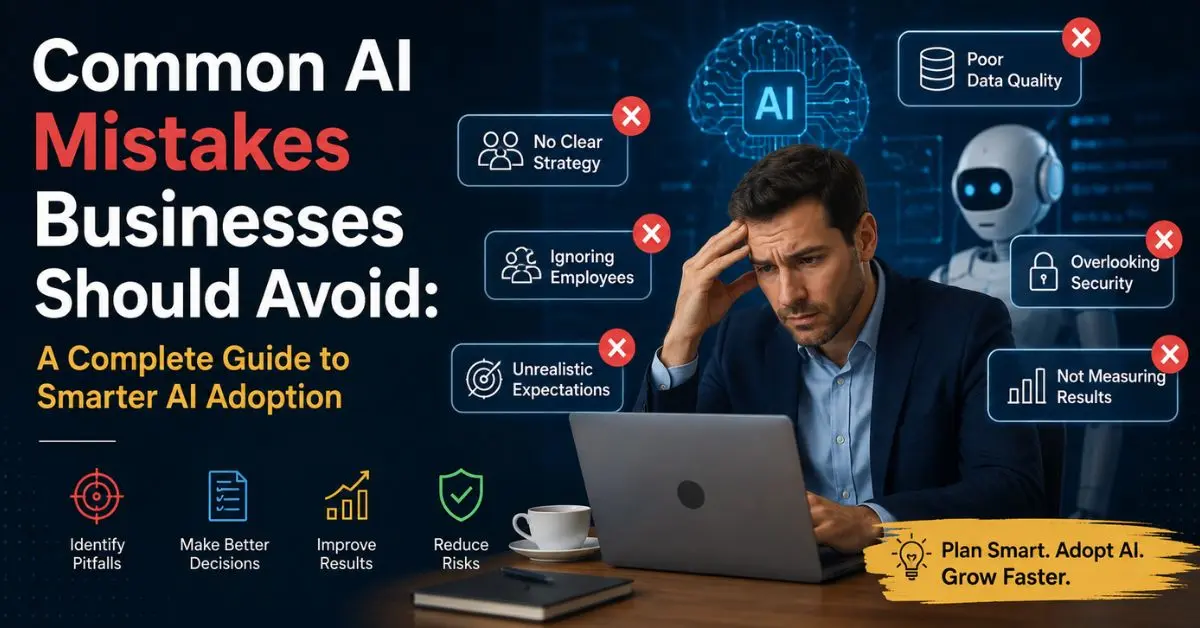
Introduction
Artificial intelligence has become one of the most valuable technologies for modern businesses. From automating repetitive tasks to improving customer service and analyzing large amounts of data, AI offers countless opportunities to increase efficiency and drive growth. However, simply adopting AI does not guarantee success. Many organizations invest significant time and money into AI projects only to face disappointing results because they overlook essential planning, preparation, and execution.
Understanding the Common AI mistakes businesses should avoid is essential for organizations of every size. Whether you run a startup, a small business, or a growing enterprise, recognizing these mistakes can help you avoid unnecessary costs and maximize the return on your investment. Businesses that approach AI strategically are more likely to improve productivity, strengthen customer relationships, and stay competitive in an increasingly digital marketplace.
Many AI failures occur because companies focus too much on technology while ignoring business goals, employee training, data quality, and customer needs. Fortunately, these problems are preventable with careful planning and realistic expectations.
This comprehensive guide explains the most common AI mistakes businesses should avoid, why they matter, and how to implement AI successfully. By following these best practices, you can reduce risks, improve decision-making, and build a stronger foundation for long-term success.
What Are Common AI Mistakes Businesses Should Avoid?
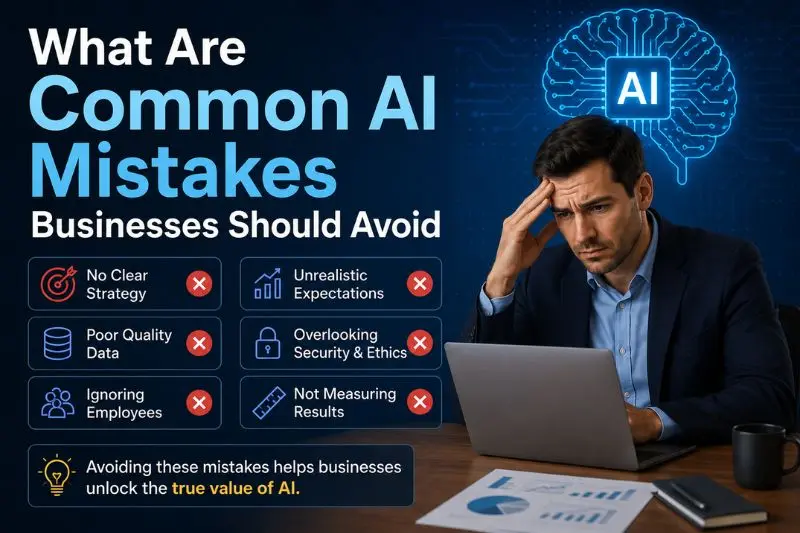
Common AI mistakes businesses should avoid are errors made before, during, or after implementing artificial intelligence solutions. These mistakes often reduce the effectiveness of AI projects and may result in wasted resources, poor customer experiences, or failed initiatives.
Businesses frequently assume AI can solve every problem without understanding its limitations. Others invest in advanced tools without preparing their employees or organizing their data properly. Some companies also neglect ethical considerations, leading to compliance issues or damaged customer trust.
Avoiding these mistakes requires a balanced approach that combines technology, business strategy, skilled employees, and continuous improvement.
Why Is It Important to Avoid Common AI Mistakes?
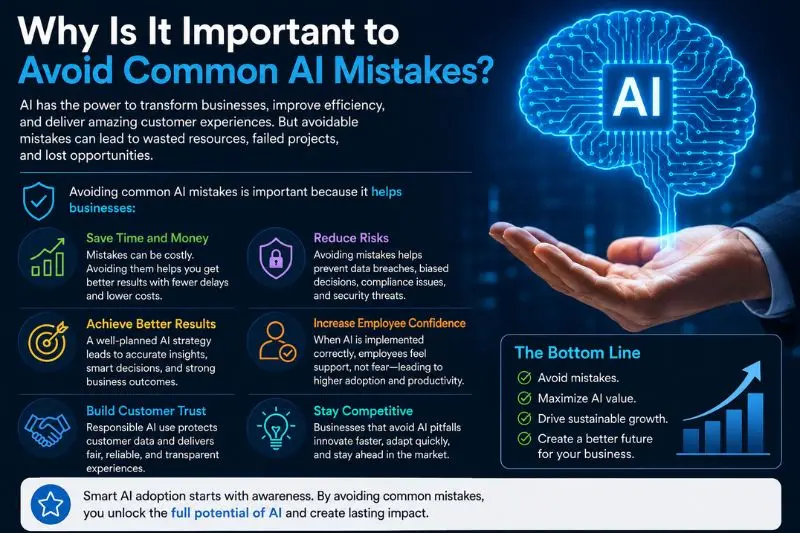
Avoiding AI mistakes helps organizations maximize the value of their investments while reducing operational risks. A well-planned AI strategy improves productivity, supports better decision-making, and creates more meaningful customer experiences.
Key reasons include:
- Protecting financial investments
- Improving operational efficiency
- Increasing customer satisfaction
- Reducing implementation failures
- Maintaining regulatory compliance
- Building customer trust
- Supporting long-term business growth
- Enhancing employee productivity
Businesses that understand potential challenges before implementation are better prepared to achieve sustainable success.
Step-by-Step Guide to Avoiding Common AI Mistakes
Step 1: Define Clear Business Objectives
Never implement AI simply because competitors are doing it.
Instead, identify specific business challenges that AI can solve. Your objectives might include reducing customer support response times, improving inventory forecasting, detecting fraud, or automating repetitive administrative tasks.
Clear goals help measure success and prevent unnecessary spending.
Step 2: Evaluate Business Readiness
Before investing in AI, assess whether your organization is prepared.
Consider factors such as:
- Existing technology infrastructure
- Data availability
- Employee skills
- Budget
- Leadership support
- Security policies
A readiness assessment prevents unrealistic expectations.
Step 3: Prioritize High-Quality Data
AI systems rely heavily on data.
Poor-quality data often produces inaccurate predictions, biased recommendations, and unreliable insights. Businesses should clean, organize, and regularly update their datasets before deploying AI solutions.
Data governance policies also improve consistency across departments.
Step 4: Start with Small Projects
Many businesses attempt large-scale AI implementation immediately.
A better approach is launching a pilot project with clearly defined goals. Small projects allow organizations to test performance, identify weaknesses, and refine processes before expanding AI across multiple departments.
Pilot programs reduce financial risk while building confidence.
Step 5: Choose the Right AI Solution
Not every AI platform fits every business.
Compare available solutions based on:
- Features
- Scalability
- Ease of integration
- Security
- Vendor support
- Cost
- Customization options
Selecting technology based on actual business needs produces better long-term results.
Step 6: Involve Employees Early
Employee resistance remains one of the biggest reasons AI initiatives struggle.
Communicate how AI will support employees instead of replacing them. Encourage participation during planning and provide opportunities for feedback throughout implementation.
When employees understand AI’s purpose, adoption becomes much smoother.
Step 7: Invest in Training
Even the most advanced AI software cannot deliver results if employees don’t know how to use it.
Offer regular training sessions covering:
- AI basics
- System operation
- Data interpretation
- Security practices
- Ethical responsibilities
Continuous learning ensures employees remain confident as AI evolves.
Step 8: Monitor Performance Continuously
AI implementation is not a one-time project.
Track key performance indicators such as productivity improvements, customer satisfaction, operational costs, and accuracy rates.
Regular monitoring allows businesses to identify problems early and optimize performance.
Step 9: Maintain Transparency
Customers increasingly want to know when AI influences decisions.
Explain how AI is used, protect customer privacy, and provide human support whenever necessary. Transparency builds trust and strengthens long-term relationships.
Step 10: Improve Continuously
Technology changes rapidly.
Regularly update AI models, review performance metrics, gather employee feedback, and adapt strategies to changing business needs. Continuous improvement keeps AI systems effective and competitive.
Benefits of Avoiding Common AI Mistakes
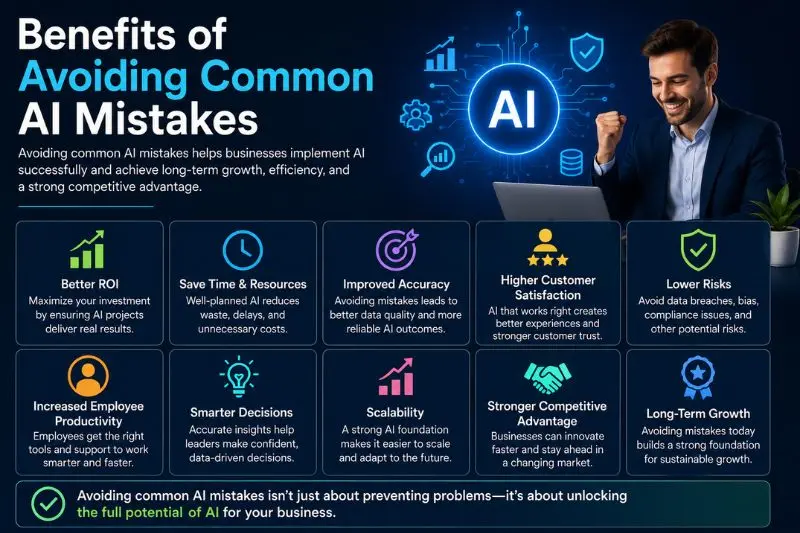
Businesses that avoid common implementation errors enjoy numerous advantages, including:
- Better return on investment
- Faster project success
- Improved customer experiences
- Higher employee confidence
- Reduced operational costs
- More accurate business insights
- Stronger data security
- Better compliance with regulations
- Increased productivity
- Enhanced decision-making
- Greater competitive advantage
- Long-term scalability
- Better collaboration across teams
- Improved innovation
- Stronger brand reputation
Disadvantages and Risks of Poor AI Implementation
Ignoring best practices can create serious business challenges.
Potential risks include:
- Wasted financial resources
- Poor-quality predictions
- Biased decision-making
- Customer dissatisfaction
- Security vulnerabilities
- Data privacy violations
- Low employee adoption
- Project delays
- Regulatory penalties
- Reduced productivity
- Loss of customer trust
- Damage to brand reputation
Understanding these risks encourages better planning and smarter implementation.
Common AI Mistakes Businesses Should Avoid
Expecting AI to Solve Every Problem
AI is a powerful tool, but it is not a universal solution.
Businesses should identify problems where AI genuinely adds value instead of forcing AI into every process.
Ignoring Data Quality
Dirty, incomplete, or outdated data leads to poor outcomes.
Investing in data management before AI implementation significantly improves results.
Choosing Technology Before Strategy
Many organizations purchase expensive AI software without defining business goals.
Always develop a clear strategy first, then select technology that supports those objectives.
Underestimating Employee Training
Employees need time and education to adapt.
Without proper training, even excellent AI systems may remain underused.
Failing to Measure Success
Organizations often launch AI projects without defining measurable outcomes.
Establish clear performance indicators such as cost savings, response times, or revenue growth.
Ignoring Ethical Considerations
AI decisions should be fair, transparent, and accountable.
Regular audits help detect unintended bias and improve fairness.
Neglecting Cybersecurity
AI systems often process sensitive information.
Implement strong access controls, encryption, and regular security assessments to reduce cyber risks.
Depending Entirely on Automation
Human oversight remains essential.
Employees should review important AI decisions, especially those affecting customers, finances, or legal compliance.
Setting Unrealistic Expectations
AI delivers results over time rather than overnight.
Businesses should establish realistic timelines and focus on continuous improvement.
Ignoring Customer Feedback
Customers provide valuable insights into AI performance.
Regularly collect feedback to improve accuracy, usability, and customer satisfaction.
Why do AI projects fail?
Most AI projects fail because businesses lack clear objectives, use poor-quality data, underestimate employee training, or expect immediate results without proper planning.
Is AI suitable for small businesses?
Yes. Small businesses can successfully use AI for customer service, marketing, inventory management, scheduling, and data analysis. Starting with small projects is usually the most effective approach.
How important is data quality in AI?
Data quality is critical because AI models learn from available information. Accurate, complete, and well-organized data produces more reliable predictions and better business decisions.
Can AI replace employees completely?
No. AI works best when supporting human expertise rather than replacing it. Employees continue to provide creativity, judgment, empathy, and strategic thinking that AI cannot fully replicate.
How can businesses measure AI success?
Success can be measured using key performance indicators such as increased productivity, reduced costs, improved customer satisfaction, higher sales, faster response times, and better decision accuracy.
How often should AI systems be updated?
Businesses should review AI systems regularly. Updates may include retraining models, improving datasets, strengthening security, and adjusting algorithms to reflect changing business requirements.
Expert Tips and Bonus Points
Follow these expert recommendations to improve AI success:
- Begin with one well-defined business problem.
- Focus on high-quality data management.
- Build cross-functional implementation teams.
- Encourage employee participation.
- Monitor performance regularly.
- Protect customer privacy.
- Maintain transparency in AI decisions.
- Invest in continuous employee learning.
- Review ethical risks frequently.
- Scale gradually after successful pilot projects.
- Keep realistic expectations.
- Combine AI insights with human expertise for the best outcomes.
Businesses that follow these practices typically achieve stronger results while minimizing unnecessary risks.
Conclusion
Artificial intelligence is transforming the way businesses operate, compete, and serve customers. However, successful AI adoption depends on more than simply purchasing advanced technology. Organizations must understand the Common AI Mistakes Businesses Should Avoid and develop thoughtful strategies that align with their long-term goals.
The most successful businesses begin with clear objectives, reliable data, employee training, and realistic expectations. They recognize that AI is a valuable business tool rather than a complete replacement for human expertise. By continuously monitoring performance, improving data quality, maintaining transparency, and protecting customer information, companies create stronger and more sustainable AI initiatives.
Avoiding common mistakes also helps businesses reduce financial risks, improve operational efficiency, strengthen customer trust, and achieve better returns on investment. Even small improvements in planning and execution can significantly increase the success of AI projects.
As artificial intelligence continues to evolve, businesses that remain flexible, invest in continuous learning, and regularly evaluate their AI strategies will stay ahead of the competition. Instead of rushing into implementation, focus on careful planning, measurable goals, and ongoing improvement. A thoughtful approach not only minimizes costly mistakes but also unlocks the full potential of AI, allowing businesses to innovate, grow, and deliver greater value to customers for years to come.
